Your independent source for
HOA education, resources, and real solutions.
Prospective Buyers
I'M THINKING ABOUT BUYING IN AN HOA
I WANT TO KNOW BEFORE I BUY.
You're not just buying a home. You're also entering a financial, governance, and community system. Learn what to examine before making the commitment.

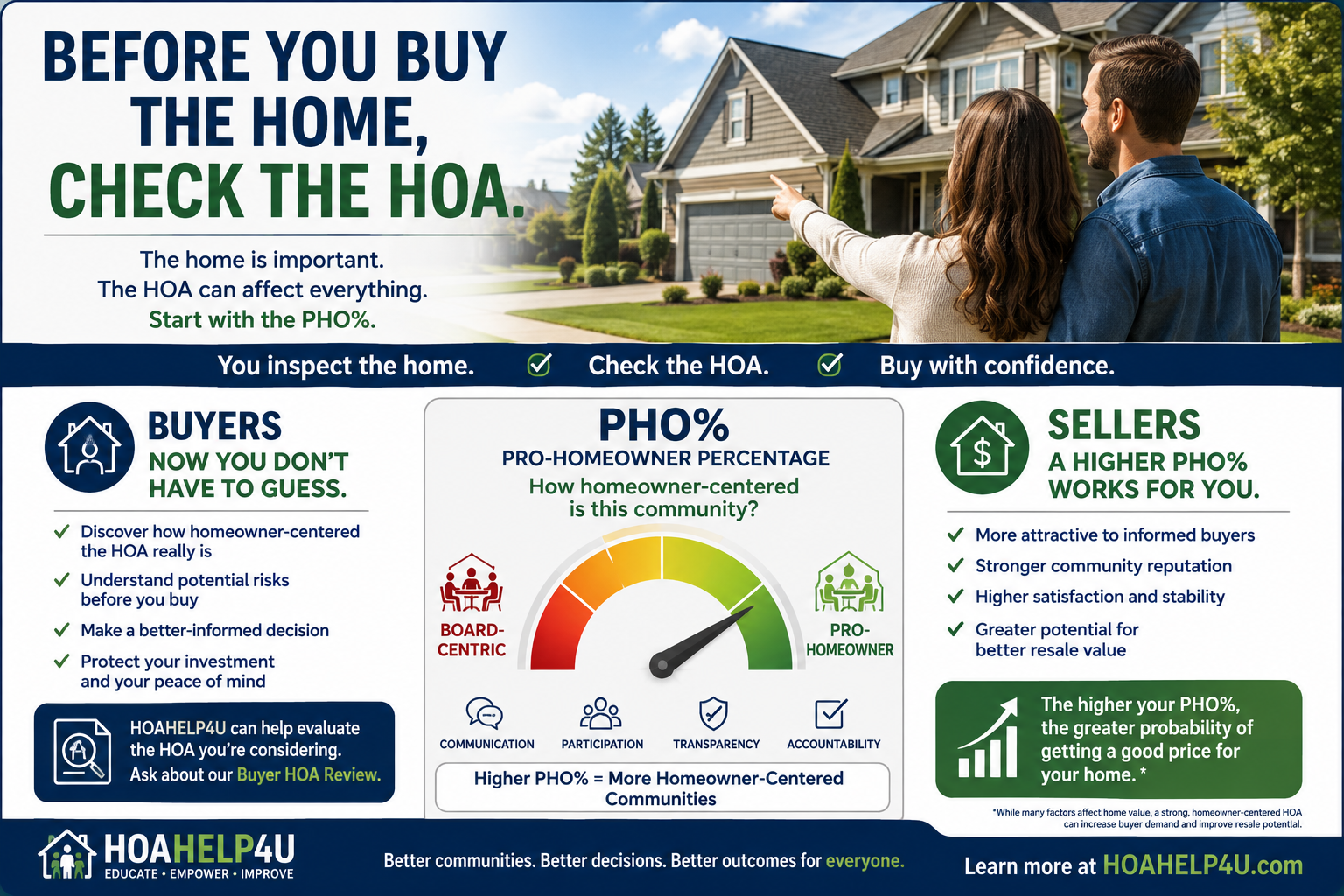
BEFORE YOU BUY THE HOME,
CHECK THE HOA.
The missing inspection
YOU INSPECT THE HOME. WHAT ABOUT THE HOA?
Buying a home is one of the largest financial decisions most people make.
Buyers inspect the roof, foundation, plumbing, electrical system, heating and air conditioning. They examine the neighborhood, schools, taxes, insurance, and financing.
But when the home is in an HOA, another important part of the purchase needs to be evaluated:

THE HOA ITSELF.
The HOA can affect your monthly expenses, future assessments, property restrictions, maintenance, amenities, finances, and your ability to have a meaningful voice in the community.
YOU AREN'T SIMPLY BUYING A HOME.
YOU'RE JOINING AN ORGANIZATION.
Before the documents
BEFORE YOU START WITH THE DOCUMENTS
Most HOA buyers are told to review:
CC&Rs
BYLAWS
RULES AND REGULATIONS
Those documents are important.
But they don't necessarily tell you what it's actually like to live in the community.
They tell you the rules and structure of the association.
They may not tell you whether homeowners are informed, whether they are meaningfully represented, whether the board listens, whether communication works, whether homeowners participate, or whether the community operates primarily around the board rather than its homeowners.
So before beginning your detailed review, ask:
WHAT IS THIS HOA'S PHO%?
The starting indication
WHAT IS PHO%?
PHO% means Pro-Homeowner Percentage.
It is designed to provide a starting indication of how homeowner-centered an HOA actually is.
A more homeowner-centered HOA seeks meaningful homeowner input, communicates effectively, encourages participation, operates transparently, maintains appropriate governance systems, and recognizes that the association exists to serve the community of homeowners.
At the other end of the spectrum is a strongly board-centric HOA, where most authority, information, communication, and decision-making remain concentrated around the board with limited meaningful homeowner participation.
PHO% is intended to help a prospective buyer begin asking an important question:
WHAT KIND OF COMMUNITY AM I ABOUT TO JOIN?
PHO% DOES NOT REPLACE BUYER DUE DILIGENCE.
IT HELPS YOU KNOW WHERE TO BEGIN.
No PHO% established yet?
NO PHO% AVAILABLE?
THAT DOESN'T MEAN YOU HAVE TO BUY WITHOUT ONE.
If you're seriously considering a home in an HOA and a PHO% has not yet been established, HOAHELP4U can help evaluate the community.
A prospective buyer can identify the HOA being considered and provide available information needed to reach homeowners in that community.
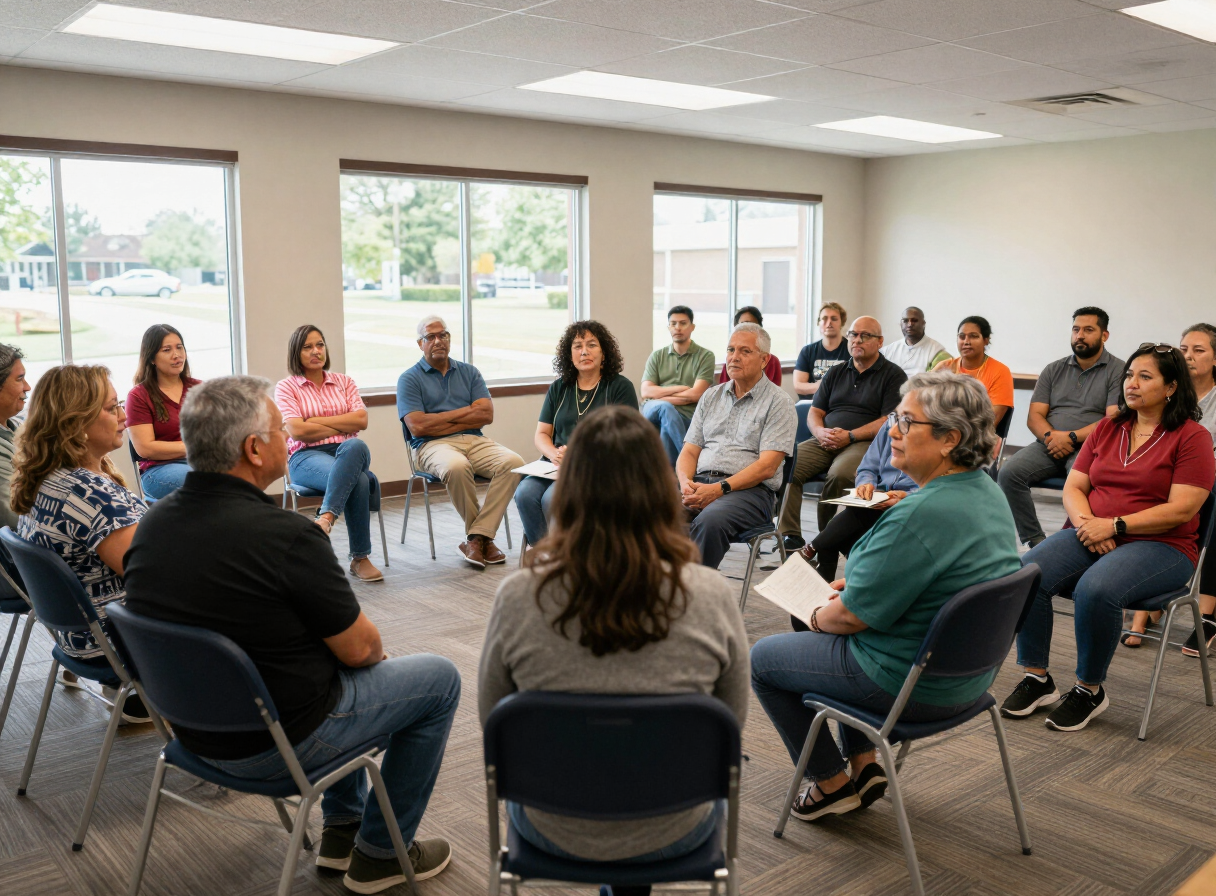
HOAHELP4U can then conduct homeowner outreach inviting community members to participate in CHAT — the Community Health Assessment Test.
CHAT responses can help develop a preliminary picture of how homeowner-centered the association is.
A single homeowner's responses do not statistically represent the entire HOA. If participation is limited, the result is clearly identified as a preliminary PHO% and the number of homeowner responses on which it is based is disclosed.
Then do your homework
BEFORE YOU BUY HOA CHECKLIST
After establishing or investigating PHO%, continue with conventional due diligence.
CHECK THE HOA’S PHO%
How homeowner-centered does the community appear to be?
REVIEW THE CC&Rs
Understand restrictions, obligations, property-use requirements, and association authority.
REVIEW THE BYLAWS
Understand how the association is governed and how directors and elections operate.
REVIEW THE RULES AND REGULATIONS
Determine how HOA rules may affect your everyday life.
REVIEW THE HOA BUDGET
Understand where homeowner assessments are going and whether current income appears adequate for operations.
EXAMINE THE RESERVES
Determine whether the association appears to be preparing adequately for future repair and replacement obligations.
ASK ABOUT SPECIAL ASSESSMENTS
Look for current, recent, or anticipated special assessments.
REVIEW MAINTENANCE AND COMMON AREAS
Don’t just look at amenities. Look at their condition and whether maintenance appears current or deferred.
LOOK AT HOA COMMUNICATION
Does the association have an active website, newsletter, email system, regular updates, or other effective ways of communicating with homeowners?
LOOK AT HOMEOWNER PARTICIPATION
Do homeowners vote, participate, serve on committees, provide input, and appear meaningfully involved in their community?
UNDERSTAND MANAGEMENT
Determine whether the HOA is professionally managed, what role management performs, and how homeowners communicate with management and the board.
LOOK FOR RED FLAGS
Consider patterns involving poor communication, financial uncertainty, deferred maintenance, inaccessible information, repeated special assessments, inconsistent enforcement, limited participation, or entrenched leadership.
Keep it in perspective
ONE RED FLAG DOESN'T NECESSARILY MEAN DON'T BUY
Every HOA can have problems.
The purpose of the checklist and PHO% is not to automatically eliminate an HOA because one concern appears.
The objective is to identify patterns, ask better questions, obtain missing information, and understand the community before becoming financially and legally committed to it.
Want to do it yourself?
BUYING A HOME IN AN HOA?
DON'T BE SURPRISED — BE INFORMED
This consumer guide was written specifically for prospective HOA buyers and provides a deeper examination of HOA finances, governance, elections, daily life, red flags, evaluation, and the final purchase decision.

Want HOAHELP4U to help?
YOU CAN DO THE RESEARCH YOURSELF —
OR HOAHELP4U CAN HELP DO THE WORK FOR YOU.
HOAHELP4U is developing a prospective-buyer service that can help buyers examine the HOA they are considering, identify areas requiring closer attention, and potentially conduct homeowner outreach to help establish a preliminary PHO%.
Before you sign
BEFORE YOU BUY, YOU STILL HAVE CHOICES.
You can ask questions. You can review the documents. You can investigate the finances. You can examine the community. You can learn how the HOA actually functions.
And you can decide whether both the home and the HOA are right for you.
DON'T BE SURPRISED.
BE INFORMED.