Your independent source for
HOA education, resources, and real solutions.
A resource of HOAHELP4U.COM
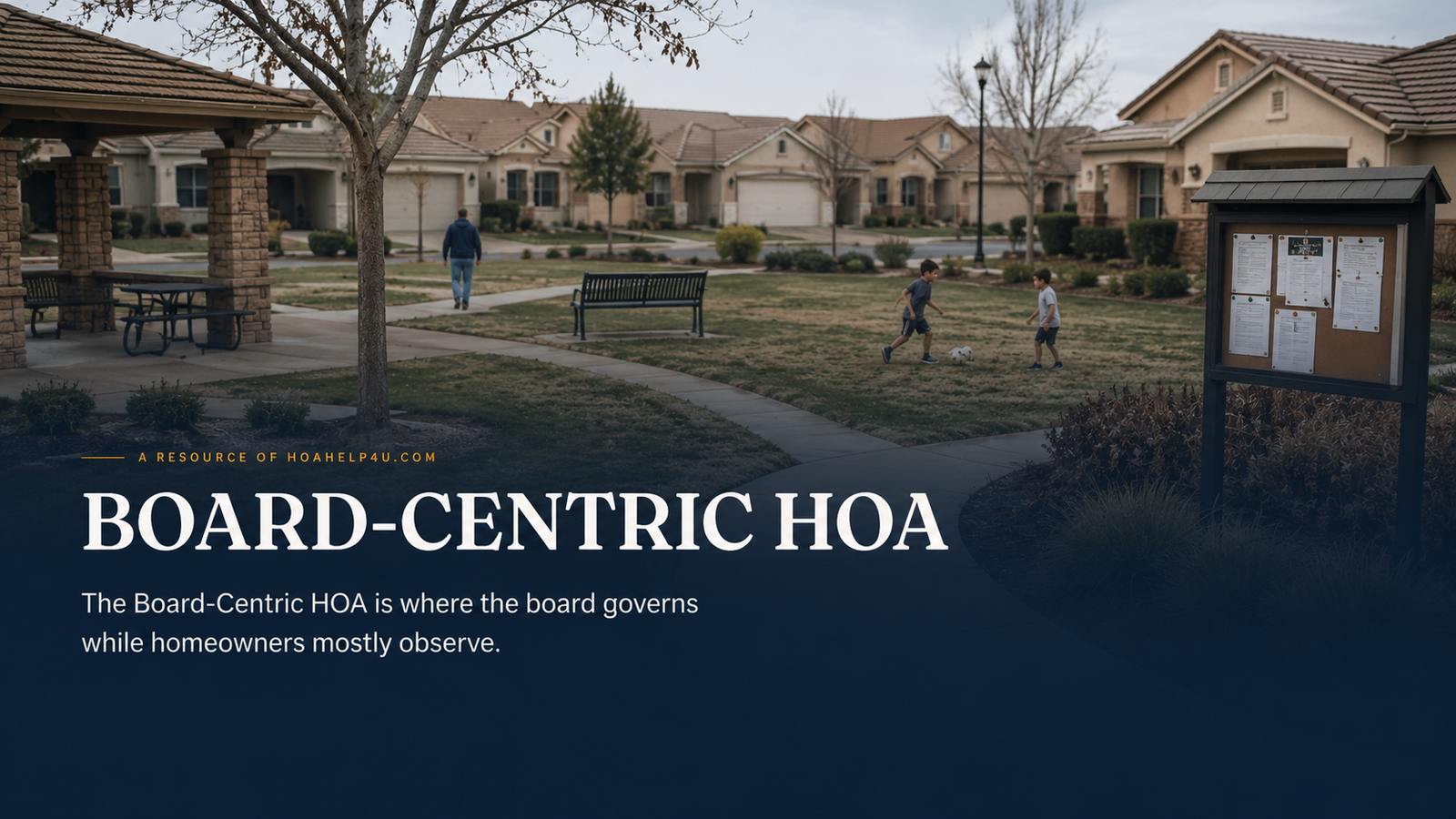
BOARD-CENTRIC HOA
The Board-Centric HOA is one model of how an HOA community can be governed. Recognizing its characteristics helps homeowners understand the role they have in their community today — and the role THE PATH can help them move toward.
Understanding the model
A MATTER OF GOVERNANCE, NOT GOOD OR BAD
A Board-Centric HOA is not automatically a poorly run HOA, and a Board-Centric board is not automatically a bad board. The distinction is about how the community is governed and the role homeowners have in that community — not about misconduct or wrongdoing.
In a Board-Centric HOA, the board governs while homeowners mostly observe. Decisions, information, and direction tend to flow from the board outward, with limited homeowner participation in the decisions that shape the community.
The core distinction
Board-Centric HOA: The board governs while homeowners mostly observe.
What it tends to look like
COMMON CHARACTERISTICS OF A BOARD-CENTRIC HOA
These characteristics describe a governance model, not a judgment of any particular board. Most Board-Centric HOAs show some of these traits — rarely all of them at once.
The Board Controls the Direction
The board establishes priorities, makes most substantive decisions, and determines the direction of the community. Homeowners elect directors, but between elections they may have little meaningful influence over governance.
Communication Is Primarily Top-Down
Information generally flows from the board and management to homeowners through notices, meetings, minutes, rules, and announcements. There may be few systematic ways for homeowner ideas and priorities to flow back into decision-making.
Homeowners Are Rarely Asked What They Think
Community-wide surveys and other methods of measuring homeowner opinion are uncommon. The board may make decisions without knowing what most homeowners actually want.
Homeowners Can Speak—But May Not Be Heard
Homeowners may attend board meetings, make comments, raise concerns, and offer suggestions. But their suggestions may be ignored, dismissed, or receive no response. Having an opportunity to speak is not the same as having a meaningful voice.
Board Meetings Are Considered "Participation"
Attendance at board meetings may be treated as the primary measure of homeowner involvement, even though meetings are designed principally for conducting board business rather than collaborative community decision-making.
Meaningful Homeowner Committees Are Limited
There may be few active homeowner committees, or committees may operate almost entirely under board control. Homeowners have limited opportunities to participate directly in solving community problems.
Management Primarily Serves the Board
The property manager's principal working relationship is with the board. Homeowners generally interact with management individually rather than through an organized homeowner participation structure.
Decisions Often Precede Homeowner Input
Decisions involving landscaping, security, amenities, rules, major projects, budgets, and other community priorities may be made before homeowners are systematically asked what they want.
Elections Are the Primary Source of Homeowner Power
The prevailing model is simple: homeowners elect directors, and directors govern. Meaningful homeowner influence may therefore be concentrated around elections rather than exercised continuously throughout the year.
Participation Is Low
Only a small percentage of homeowners may attend meetings, volunteer, serve on committees, respond to communications, or become involved in community affairs.
A Small Group Carries the Community
Board members and a handful of active homeowners may perform most community functions year after year. This can produce burnout, entrenched leadership, and difficulty developing future community leaders.
Transparency Means Disclosure Rather Than Engagement
The HOA may provide legally required notices, minutes, budgets, records, and meetings while still giving homeowners little meaningful involvement in establishing community priorities.
Success Is Defined Operationally
Success may be measured primarily by balanced budgets, maintained property, rule enforcement, completed projects, reserve funding, and legal compliance. Those matter—but they don’t measure whether homeowners feel heard, represented, informed, connected, or involved.
Community Building Is Secondary
The HOA operates primarily as an organization that manages property, collects assessments, enforces rules, and maintains common areas rather than as an organization designed to build a strong homeowner community.
Homeowner Sentiment Isn’t Measured
The board may know how many homeowners attend meetings or complain, but not what percentage are satisfied, what their priorities are, whether they trust their HOA, or whether they believe they are represented.
Homeowners React Instead of Participate
Many homeowners become involved only after something directly affects them—a violation, assessment increase, rule change, landscaping problem, election controversy, or major expenditure. There is little infrastructure for continuous participation before problems develop.
When concentrated governance deepens
MORE SERIOUS WARNING SIGNS
These characteristics do not exist in every Board-Centric HOA. When they do appear, however, they may indicate that concentrated governance has developed into something more troubling.
"That’s How We Do It" Replaces Proper Procedure
Boards may establish practices according to custom or preference without adequately checking governing documents or applicable law. Elections, meetings, records access, committees, and homeowner participation can become governed by whatever procedures the board has traditionally followed.
Questioning Homeowners Become Adversaries
Homeowners who repeatedly ask questions, request records, challenge expenditures, or advocate for change may be treated as problems rather than participants. Attention can shift from addressing their concerns to criticizing, labeling, excluding, or discouraging the homeowner.
Different Standards Apply to Homeowners and the HOA
Homeowners may face strict enforcement of landscaping, maintenance, architectural, or appearance standards while comparable deficiencies in HOA-controlled common areas remain unresolved. Accountability should apply to the HOA as well as the homeowner.
Financial Reports Don’t Necessarily Explain What Homeowners Are Buying
Broad accounting categories can obscure the actual services being provided. An expense labeled "Security," for example, might substantially involve parking monitoring and enforcement. Homeowners should be able to understand not merely how much was spent, but what they received for the money and whether it reflects community priorities.
The structure an individual homeowner faces
THE BOARD-CENTRIC “IRON DOME”
An individual homeowner who attempts to change a strongly Board-Centric HOA can encounter a formidable structure.
The board possesses decision-making authority. Management provides professional administration. Association attorneys provide legal advice and representation. These services are generally paid for with HOA funds supplied by the homeowners themselves.
Meanwhile, the individual homeowner may be working alone, using personal time and personal money. The final—and often most powerful—part of the Iron Dome is homeowner apathy or disengagement. When most homeowners don’t participate, ask questions, vote, volunteer, respond to surveys, or support neighbors raising legitimate concerns, an individual homeowner can become isolated.
THE PATH CHANGES THE EQUATION
THE PATH isn’t designed to create a more powerful individual homeowner who can fight the Iron Dome.
It builds something more powerful: an informed, connected and participating community of homeowners.
THE TRANSFORMATION THE PATH IS DESIGNED TO ACCOMPLISH
THE PATH helps homeowners move from a Board-Centric HOA toward a Pro-Homeowner HOA — a community where the board represents while homeowners participate.
WHERE DID WE START — CHAT - PHO%
WHERE ARE WE GOING? — GOLD STANDARD
HOW DO WE GET THERE? — THE PATH
COMMUNITY IS THE ENGINE — AND THE DESTINATION.
TAKE THE CHAT — START HERE