Your independent source for
HOA education, resources, and real solutions.
A resource of HOAHELP4U.COM
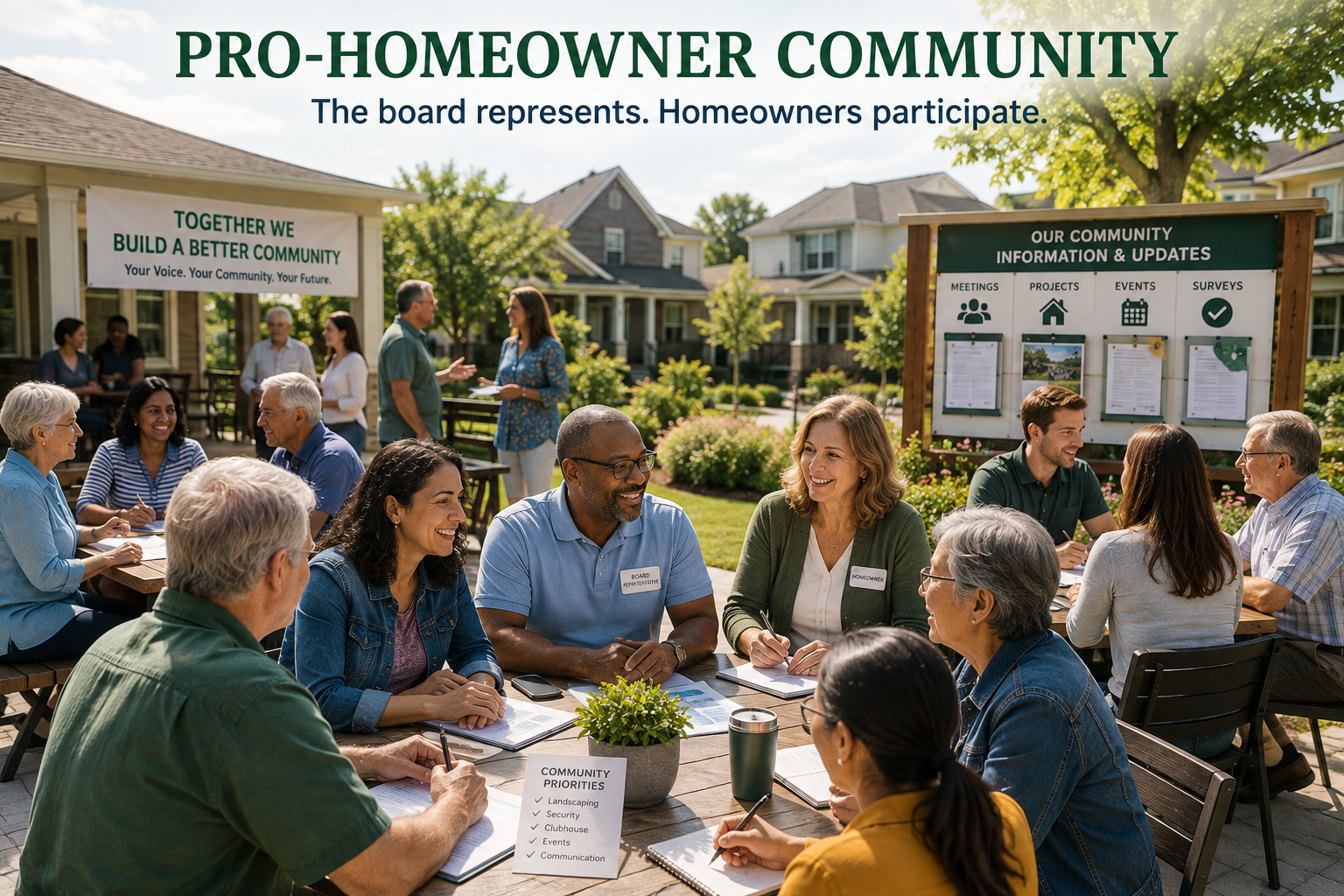
PRO-HOMEOWNER HOA
The Pro-Homeowner HOA is the destination THE PATH is designed to help homeowners reach — a community where the board represents while homeowners participate.
Understanding the model
A COMMUNITY WHERE HOMEOWNERS PARTICIPATE
In a Pro-Homeowner HOA, the board represents while homeowners participate. Decisions, information, and direction flow two ways — with homeowners meaningfully involved in the decisions that shape their community.
This is not a criticism of boards or board members. It is a different model of governance — one in which the board's role is to represent homeowners, and homeowners' role is to participate.
The core distinction
Pro-Homeowner HOA: The board represents while homeowners participate.
What it tends to look like
QUALITIES OF A PRO-HOMEOWNER COMMUNITY
These qualities describe a community where governance and participation work together. Most Pro-Homeowner communities develop several of these traits — and continue building on them over time.
The Board Represents; It Does Not Rule
Directors retain their legal responsibilities and decision-making authority, but actively seek to understand and represent homeowner priorities. The board governs on behalf of the community rather than apart from it.
Communication Flows Both Ways
The board and management communicate regularly with homeowners, while homeowners have reliable ways to communicate ideas, concerns, priorities, and feedback back to community leadership.
Homeowners Are Regularly Surveyed
The community does not guess what homeowners think. Short surveys are conducted regularly—potentially monthly—to measure satisfaction, identify priorities, test ideas, and determine whether changes are working. Results are shared with homeowners.
Homeowner Input Influences Decisions
Participation is not ceremonial. Suggestions and concerns are acknowledged, evaluated, answered, and, where appropriate, incorporated into community decisions.
Participation Extends Beyond Board Meetings
Homeowners have multiple ways to participate according to their interests, abilities, available time, and experience. Community involvement is not limited to attending board meetings or running for office.
Meaningful Homeowner Committees Do Real Work
Committees provide homeowners direct opportunities to participate in landscaping, finance, communications, social activities, safety, architectural matters, community improvement, and other important functions.
Major Decisions Begin With Homeowner Input
Before significant expenditures, amenity changes, new programs, major projects, or important community initiatives, leadership seeks to understand homeowner priorities.
Management Serves the Community as Well as the Board
Management supports the board’s governance responsibilities while recognizing homeowners as members of the association whose questions, concerns, and participation deserve professional attention.
Finances Are Understandable, Not Merely Disclosed
Homeowners should be able to determine where their money goes, what services they receive, why significant expenditures are necessary, and whether spending reflects community priorities.
The HOA Holds Itself to the Standards It Expects of Homeowners
Common areas, landscaping, maintenance, transparency, procedures, and organizational conduct should demonstrate the same level of accountability expected from individual homeowners.
Questions and Constructive Disagreement Are Welcomed
Homeowners who ask questions, request information, challenge assumptions, or disagree with leadership are treated as participating members of the community rather than adversaries.
Success Includes Community Health
Financial stability, reserves, legal compliance, maintenance, and sound operations remain essential. But success also includes homeowner satisfaction, participation, trust, communication, representation, and community connection.
Community Is Deliberately Built
A strong community does not happen automatically. Newsletters, websites, committees, surveys, events, volunteer opportunities, welcoming programs, and neighbor-to-neighbor relationships help homeowners become connected.
Leadership Is Continually Renewed
Homeowners are encouraged to participate, volunteer, join committees, develop leadership skills, and eventually consider board service. Leadership does not depend permanently upon the same small group.
Homeowners and the Board Operate as a Team
The board retains its legal responsibilities, but governance is no longer viewed as “us and them.” Board members, management, committees, and homeowners work toward shared community goals.
Participation requires structure
THE INFRASTRUCTURE OF A PRO-HOMEOWNER COMMUNITY
Participation does not happen by accident. A Pro-Homeowner Community builds permanent infrastructure that keeps homeowners informed, involved, and represented.
Regular Homeowner Surveys
Use short surveys regularly—potentially monthly—to measure homeowner satisfaction, identify priorities, evaluate ideas, and determine whether community initiatives are working.
Monthly Committee Reports
Active committees provide brief monthly reports explaining what they examined, what they accomplished, what remains unresolved, and what they recommend.
Monthly Board Community Report
In addition to formal meeting minutes, the board provides homeowners a concise monthly report describing current priorities, important decisions, progress on projects, unresolved matters, and issues ahead.
An Up-to-Date Community Website
The website is a living community resource rather than an electronic filing cabinet. It contains current announcements, calendars, committee information, surveys, reports, project updates, governing documents, volunteer opportunities, and clear ways for homeowners to participate.
A Regular Community Newsletter
The newsletter explains what is happening in plain language, summarizes progress and survey results, recognizes volunteers, introduces community initiatives, and helps homeowners remain connected even when they cannot attend meetings.
A Brainstorming Committee
Create a committee whose primary question is “How could we make our community better?” The committee invites ideas, researches possibilities, examines successful practices elsewhere, and presents promising ideas for community consideration.
Outreach to Other HOAs
A Pro-Homeowner Community does not operate in isolation. It develops relationships with other HOAs, exchanges ideas, compares successful practices, learns from their experiences, and shares innovations that work.
A PATH Committee
A homeowner-based PATH Committee helps keep the transformation moving. It can coordinate surveys, monitor progress toward the Gold Standard, encourage participation, identify obstacles, and help prevent the Pro-Homeowner model from disappearing when board membership changes.
Progress Is Measured and Reported
The community periodically measures its progress using CHAT, the Gold Standard, homeowner participation, satisfaction, transparency, communication, committee activity, and other meaningful indicators. Homeowners should be able to see whether their community is actually improving.
How the parts work together
COMMUNITY INFRASTRUCTURE
A Pro-Homeowner HOA does not rely on any one person or group. It distributes participation throughout the community.
No single homeowner has to carry the community. No board has to carry it alone either.
A Pro-Homeowner HOA distributes participation throughout the community. The board provides representation and leadership. Management provides professional support. Committees bring homeowner knowledge and energy into community affairs. Surveys provide a continuing homeowner voice. Reports, the website, and the newsletter keep everyone informed.
The result is not less governance. It is better-informed governance supported by an involved community.
A community that keeps improving
THE PRO-HOMEOWNER OPERATING SYSTEM
A Pro-Homeowner Community is never “finished.” Homeowners are continually heard, opportunities for participation remain open, results are reported, progress is measured, and the community keeps improving.
WHERE DID WE START — CHAT - PHO%
WHERE ARE WE GOING? — GOLD STANDARD
HOW DO WE GET THERE? — THE PATH
COMMUNITY IS THE ENGINE — AND THE DESTINATION.
TAKE THE CHAT — START HERE